


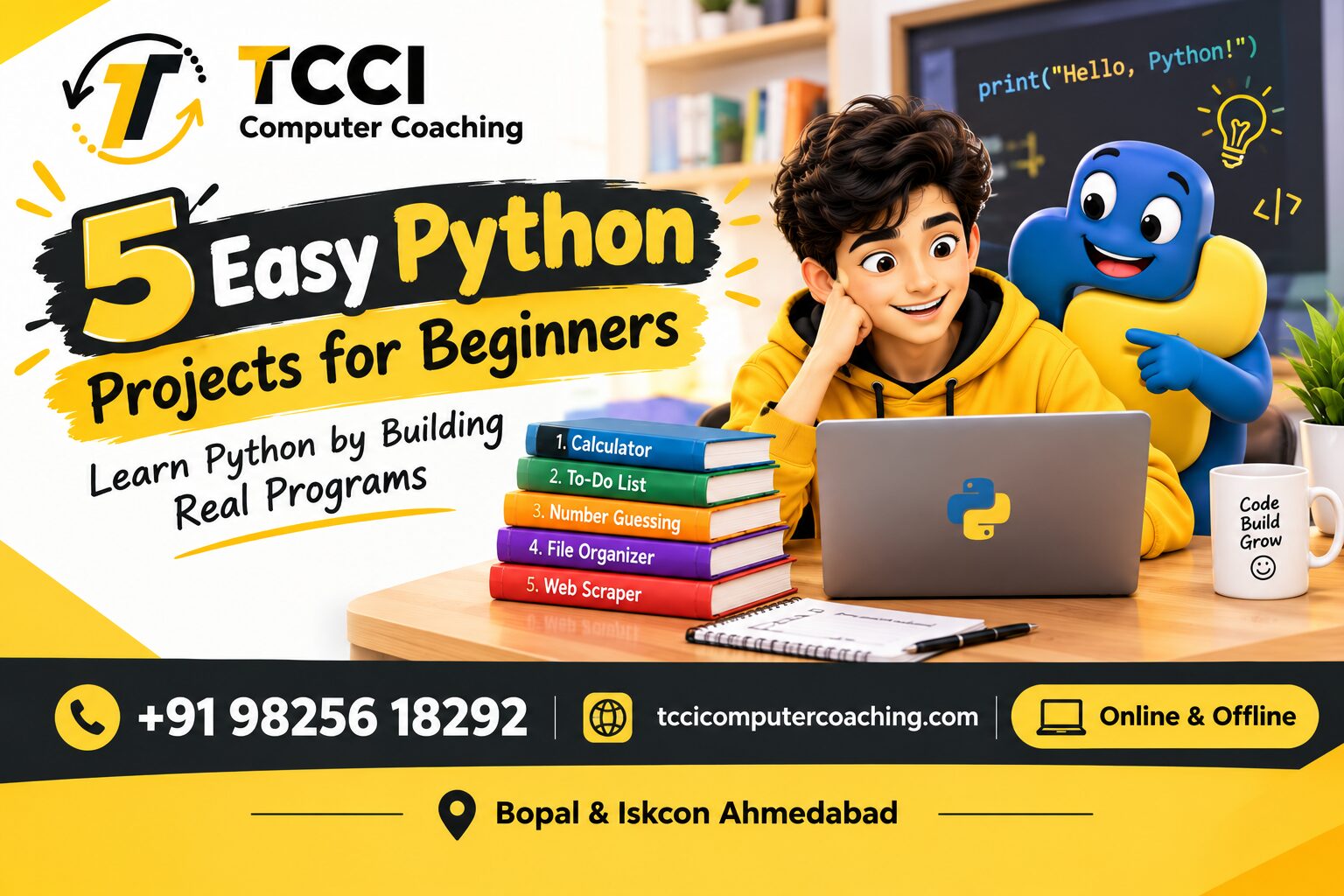
Learning Python is easier when you move beyond tutorials and start building real programs. For beginners, Python projects are a practical way to understand programming concepts, improve problem-solving skills, and gain confidence by applying what you learn.
If you have recently started learning Python and are wondering what to build, here are 5 easy Python projects for beginners that can help you practice important programming concepts step by step.
Why Should Beginners Build Python Projects?
Watching tutorials and reading Python syntax can help you understand the basics, but building programs gives you an opportunity to apply those concepts.
Beginner Python projects can help you practice:
- Variables and data types
- Conditional statements
- Loops
- Functions
- Lists and dictionaries
- User input
- File handling
- Basic problem-solving
You do not need to build a complicated application when you are starting. Simple projects can provide a strong foundation for more advanced Python programming.
1. Python Calculator
A calculator project in Python is one of the easiest projects to start with.
You can create a program that asks the user for two numbers and allows them to perform operations such as:
- Addition
- Subtraction
- Multiplication
- Division
This project helps beginners practice variables, user input, operators, conditional statements, and functions.
Once the basic calculator works, you can improve it by adding more operations and input validation.
2. Number Guessing Game
A number guessing game is a simple and fun way to practice Python programming.
The program generates a number, and the user tries to guess it. The program can provide hints such as whether the guess is too high or too low.
This project helps you understand:
- Loops
- Conditional statements
- User input
- Random numbers
- Comparison operators
It also introduces beginners to the idea of creating an interactive program.
3. To-Do List Program
A Python to-do list project is useful for learning how programs can store and manage information.
You can create a simple application where users can:
- Add tasks
- View tasks
- Remove completed tasks
- Update tasks
This project can help you practice lists, loops, functions, and user input. You can later improve it by storing tasks in a file so that they remain available when the program is reopened.
4. Simple Quiz Game
A quiz game is another beginner-friendly Python project.
You can create multiple questions with different answers and calculate the user’s final score.
This project can help you practice dictionaries or lists, conditional statements, loops, functions, and basic program logic.
You can also add different difficulty levels or categories as you become more comfortable with Python.
5. Expense Tracker
Once you understand the basics, try creating a simple Python expense tracker.
The program can allow users to enter expenses and organize information such as:
- Expense amount
- Category
- Date
- Description
A beginner version can store the information in lists or dictionaries. Later, you can introduce file handling and data analysis to make the project more advanced.
How to Learn Python Through Projects
The most important thing is not how many projects you build. It is what you learn while building them.
Start with a small project and try to build it yourself before looking at complete solutions. When you encounter an error, understand why it happened and try to fix it.
A useful learning path is:
Learn a concept → Build a small feature → Test it → Find errors → Fix them → Improve the project.
This approach can gradually improve both your Python knowledge and problem-solving ability.
Learn Python and Build Practical Skills
If you want structured guidance while learning Python, TCCI – Tririd Computer Coaching Institute offers Python training focused on developing programming skills through concepts and practical learning.
TCCI also provides courses in C, C++, Java, Web Development, SQL & Database, Data Science, AI/ML, Power BI, Advanced Excel, and MS Office.
Final Thoughts
These 5 easy Python projects for beginners—a calculator, number guessing game, to-do list, quiz game, and expense tracker—can help you move from learning Python syntax to actually building programs.
You do not need to start with a complex application. Begin with a small idea, understand the concepts involved, and keep improving your project.
The best way to learn Python is not just to read code—it is to write, test, fix, and build with it.